


Is Your Business Running on Isolated Systems or an Integrated ERP?
As a business grows, managing day-to-day operations becomes more complicated.
HR manages employees.
Accounting manages finances.
Sales manages customers and orders.
Procurement manages suppliers.
Inventory manages stock.
CRM manages customer relationships.
Sales teams manage field activities and follow-ups.
But there is one important question:
Are all these departments working with the same information, or is every department using a separate system?
The Problem with Separate Systems
Many businesses start by using different software for different departments.
At first, this may seem like a simple and practical solution. But as the business grows, disconnected systems can create new problems.
1. Duplicate Data Entry
The same customer, supplier, product, employee, or transaction may have to be entered into multiple systems.
This wastes time and increases the possibility of mistakes.
2. Different or Incorrect Information
If information is updated in one system but not another, different departments may be working with different versions of the same information.
For example, the sales team may have one customer balance while accounting has another.
3. Limited Business Visibility
Management may need information from HR, sales, inventory, finance, and other departments to understand what is really happening in the business.
When data is scattered across different applications, getting a complete picture becomes difficult.
4. Manual Reporting
Employees may have to export information from different systems, combine Excel files, check the data, and prepare reports manually.
This takes time and delays decision-making.
5. Disconnected Processes
A sales order may not automatically update inventory.
A purchase may not immediately reach the accounting system.
Attendance may need to be manually transferred to payroll.
These small gaps can create a lot of unnecessary work.
The result?
More manual work.
More data duplication.
More chances of errors.
More delays.
Less visibility.
What Changes with an Integrated ERP?
An Enterprise Resource Planning (ERP) system connects different business functions through a common platform and shared business data.
Instead of running the business as separate departments, an integrated ERP helps connect those departments into one business workflow.
For example:
Sales → Inventory → Accounts → Receivables
When a sales transaction is completed, the related inventory and financial processes can be connected within the same system.
Similarly:
Purchase → Inventory → Accounts Payable
A purchase transaction can connect procurement, inventory, supplier information, and accounting.
And:
HR → Attendance → Payroll → Accounting
Employee information and attendance data can support payroll processing and related accounting activities.
This is where ERP becomes more than just software.
It becomes a connected business platform.
One Business. One Connected System.
A modern ERP can connect many areas of an organization, such as:
-
Human Resource Management
-
Payroll
-
Finance & Accounting
-
Sales Management
-
Purchase & Procurement
-
Inventory & Warehouse
-
CRM
-
Sales Force Automation
-
Production Management
-
Project Management
-
Fixed Assets
-
Customer & Supplier Management
-
Business Intelligence & Reporting
-
Employee Self-Service
-
Workflow & Approval Management
-
Branch & Multi-Company Management
-
And many other business processes
But the real value of ERP is not simply having many modules.
The real value is how those modules work together.
Why Does ERP Integration Matter?
1. One Source of Business Information
Customer, supplier, product, employee, inventory, sales, and financial information can be managed through a connected system.
This helps reduce duplicate data and improves consistency.
2. Better Access to Current Information
Connected transactions allow authorized users and management to access more up-to-date business information.
Instead of waiting for different departments to prepare reports, information can be available through the system.
3. Automated Workflows
Business processes can move from one department to another based on predefined rules, approvals, and workflows.
For example:
Purchase Request → Approval → Purchase Order → Goods Receipt → Invoice → Payment
The process becomes easier to track and control.
4. Less Manual Work
Employees spend less time copying information between applications and more time focusing on productive business activities.
5. Better Management Visibility
Management can see information across departments and generate consolidated reports from connected business data.
This can make it easier to monitor:
Sales + Inventory + Finance + HR + Operations
in one place.
6. Easier Business Expansion
As your organization grows, an ERP can provide a common platform for adding:
Branches + Employees + Products + Customers + Suppliers + Departments
without creating completely separate systems for every new operation.
PowerBrain.ERP Is More Than Software
An ERP should not be seen simply as another application installed on a computer or server.
It should support the way your business operates.
Think about a simple customer order.
A customer places an order.
What happens next?
Does inventory need to be updated?
Does the sales team need to follow up?
Does finance need to record the transaction?
Is payment received or still outstanding?
Does the warehouse need to deliver the goods?
Does management need to see the transaction in its reports?
With a connected ERP, these activities can become part of one business process.
People + Processes + Data + Technology = Connected Operations
That is the real purpose of ERP.
The Real Question for Your Business
Don't ask only:
"How many software systems are we using?"
Ask:
"How well are our systems connected?"
If your HR, Accounting, Sales, Procurement, CRM, Inventory, Production, and other departments are working independently, it may be time to evaluate whether an integrated ERP can simplify your business operations.
Because modern businesses don't necessarily need more software.
They need:
Connected Processes
Reliable Information
Automated Workflows
Better Visibility
Faster Access to Business Insights
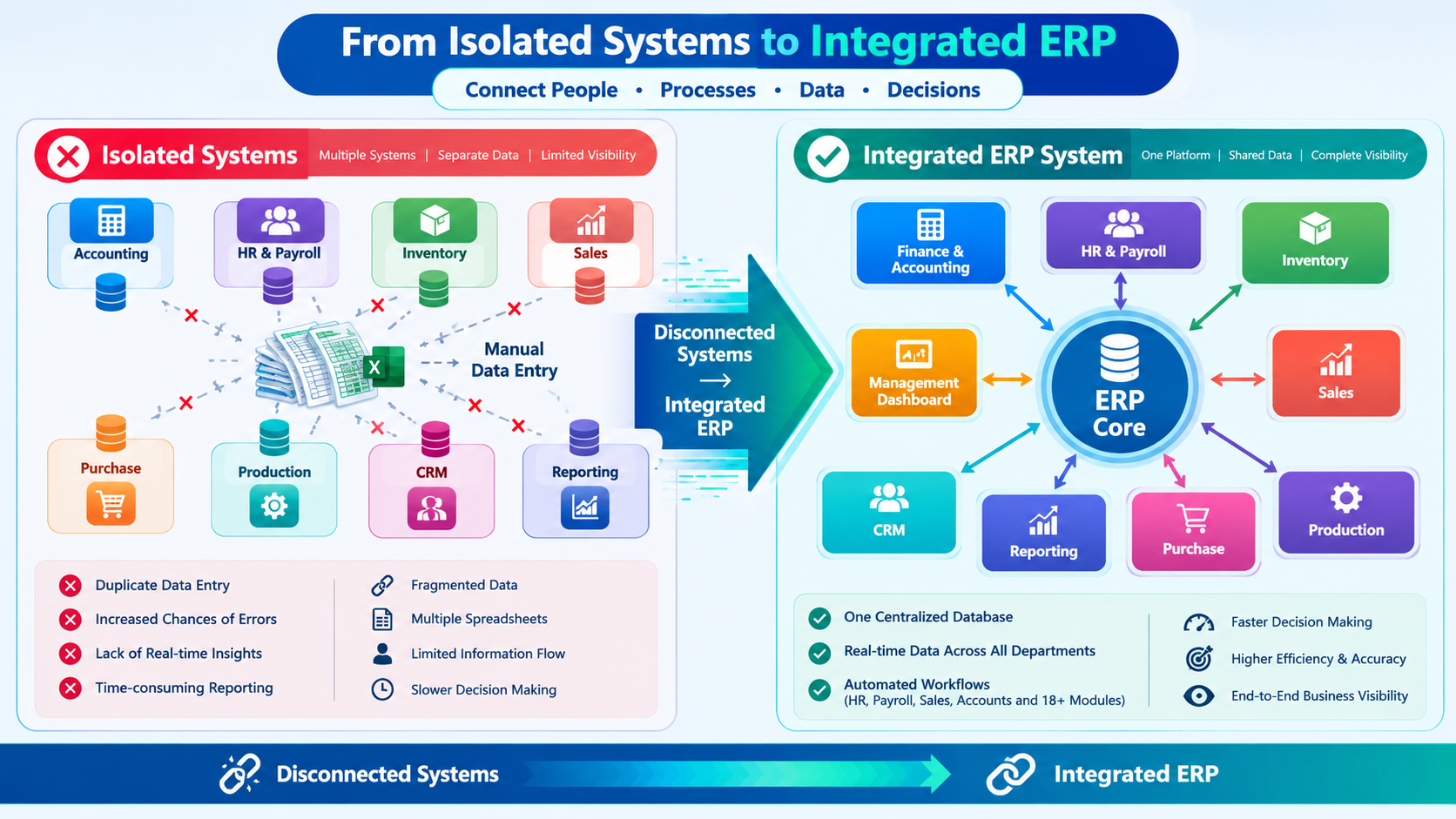
From Disconnected Systems to Connected Operations
An integrated ERP can help businesses move from:
Disconnected Systems → Connected Operations
Duplicate Data → Centralized Information
Manual Processes → Automated Workflows
Delayed Reports → Faster Business Insights
Departmental Silos → Organization-Wide Visibility
Multiple Applications → Integrated Business Platform
Build a More Connected Business
The future of business management is not simply about having more software.
It's about making your software, people, data, and processes work together.
An integrated ERP can help your organization connect departments, streamline workflows, improve visibility, and build a stronger foundation for growth.
Is your business ready to move from disconnected systems to connected operations?
For more information about ERP solutions and business process integration, contact us:
📞 +9779801827850
Related Post

21 Mar, 2024
HRMS (Human Resource Management Software) involves overseeing employee-related processes, such as recruitment, training, performance evaluation, and payroll, to ensure organizational effectiveness and employee satisfaction.

22 Feb, 2022
Fixed assets management is an accounting process that designed to track, manage, and monitor the entire lifecycle of your assets.

21 Aug, 2024
Explore the essential benefits of CRM systems for business owners. Learn how to enhance customer relationships, streamline operations, and make data-driven decisions for business growth.


